Road markings
Painted on the carriageway. A solid line is a prohibition, not decoration.
40 signs
-
 V 1a Solid longitudinal line The marking is used chiefly to separate lanes carrying traffic in opposite directions, to separate part of the lanes at a junction approach, and to separate part of a turning-off or slip lane from the through lane.
Where the marking separates lanes carrying traffic in opposite directions, the driver must travel to the right of it.
Crossing the marking or overhanging it with a load is prohibited, unless it is necessary in order to pass an obstruction, to overtake a cyclist, to turn into a place lying off the road, or to enter the road.
-
 V 1b Double solid longitudinal line The marking is used to separate opposing lanes on a carriageway with more than two lanes. In justified cases it may also be used on a carriageway with two lanes.
The driver must travel to the right of this marking.
Crossing the marking or overhanging it with a load is prohibited, unless it is necessary in order to pass an obstruction.
-
 V 2a Broken longitudinal line The marking is used to indicate and separate lanes. It is used to separate opposing lanes on sections where there is sufficient visibility for overtaking and where there is no place calling for increased caution.
The marking may be crossed subject to the relevant provisions of the general rules of the road.
The marking is laid out with gaps twice the length of the strokes.
-
 V 2b Broken longitudinal line The marking is used to indicate and separate lanes on a section where the broken line changes into a solid line, or to warn of a place calling for increased caution such as a bend or a junction.
The marking may be crossed subject to the relevant provisions of the general rules of the road.
The marking is laid out with gaps of the same length as the strokes, or half their length.
-
 V 2c Double broken longitudinal line The marking indicates a lane used alternately for one direction of travel and the other. Where the lane is not being used in this way, this marking has the same meaning as a broken longitudinal line.
-
 V 3 Solid line alongside a broken line Where this marking separates lanes carrying traffic in opposite directions, only the right-hand line of the pair applies to the driver.
Where it marks lanes in one direction of travel, the line nearer to the driver applies.
-
 V 4 Edge line The marking indicates the edge of the carriageway.
-
 V 5 Solid transverse line The marking indicates the boundary of a junction. It may be used to indicate a place for stopping a vehicle within a junction.
-
 V 6a Solid transverse line with the "Give way" symbol The marking indicates the boundary of a junction. It may be used to indicate a place for stopping a vehicle within a junction.
-
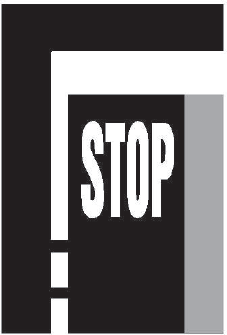 V 6b Solid transverse line with the word STOP The marking indicates the boundary of a junction.
It indicates the place where the driver must stop the vehicle as ordered by the sign "Stop and give way".
-
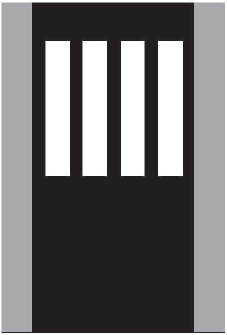 V 7a Pedestrian crossing The marking indicates a place designated for pedestrians to cross the road.
-
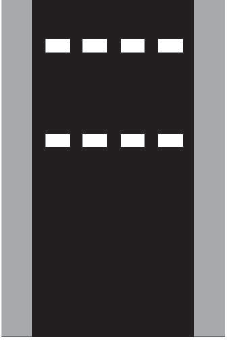 V 7b Crossing place The marking indicates a place adapted for pedestrians to cross the road.
The driver of a vehicle must not endanger a pedestrian crossing the road at a crossing place.
Before stepping onto the carriageway, the pedestrian must make sure they can cross without endangering themselves or other road users. A pedestrian may cross the carriageway only where, given the distance and speed of approaching vehicles, they will not force the drivers to change direction or speed.
-
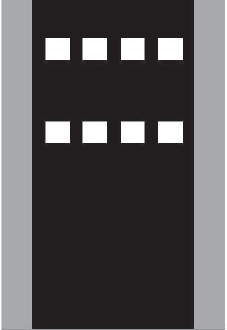 V 8a Cycle crossing The marking indicates an area designated for cyclists to ride across the road.
-
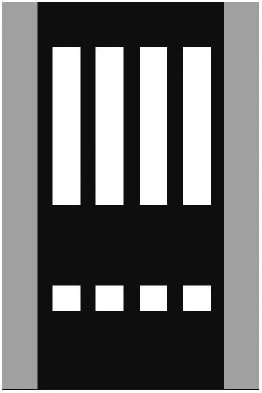 V 8b Cycle crossing adjoining a pedestrian crossing The marking indicates an area designated for cyclists to ride across the road immediately adjoining a pedestrian crossing.
The area designated for cyclists may be highlighted by a prescribed symbol or by the marking "Cycle lane".
-
 V 8c Combined pedestrian and cycle crossing The marking indicates a pedestrian crossing combined with an area designated for cyclists to ride across the road, at the point where a shared path for pedestrians and cyclists crosses another road.
-
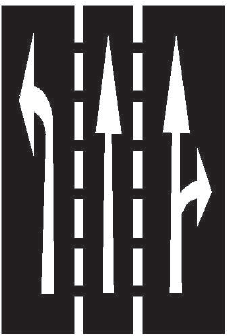 V 9a Directional arrows The arrows indicate how to get into lane before a junction or a turning-off point, and the prescribed direction of travel.
The arrows may also be used to confirm a direction of travel laid down elsewhere.
Temporary traffic regulation may be marked using only the outline of this marking.
-
 V 9b Warning arrows The marking indicates that a broken longitudinal line is about to become a solid one, and the driver's related duty to move into the appropriate lane in good time.
-
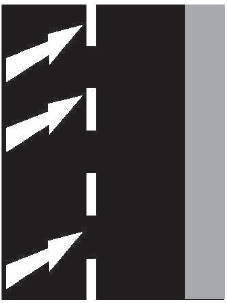 V 9c Warning arrows The marking indicates that a lane is about to end. The driver must move into the through lane in good time.
-
 V 10a Parallel parking bay The marking indicates where stopping and parking are permitted and, where relevant, prescribes the manner of parking relative to the edge of the road. When parked, the vehicle must not overhang the marked area into the carriageway with its body or its load.
-
 V 10b Perpendicular parking bay The marking indicates where stopping and parking are permitted and, where relevant, prescribes the manner of parking relative to the edge of the road. When parked, the vehicle must not overhang the marked area into the carriageway with its body or its load.
-
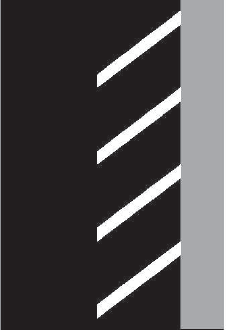 V 10c Angled parking bay The marking indicates where stopping and parking are permitted and, where relevant, prescribes the manner of parking relative to the edge of the road. When parked, the vehicle must not overhang the marked area into the carriageway with its body or its load.
-
 V 10d Parking lane The marking indicates where stopping and parking are permitted. When parked, the vehicle must not overhang the marked area into the carriageway with its body or its load.
-
 V 10e Reserved parking bay The marking indicates where stopping and parking are permitted and, where relevant, prescribes the manner of parking relative to the edge of the road. When parked, the vehicle must not overhang the marked area into the carriageway with its body or its load.
Suitable wording on the marking may indicate who the parking is reserved for.
-
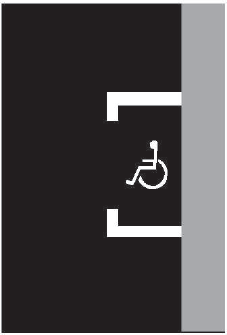 V 10f Parking reserved for a vehicle carrying a person with a severe disability or a severe mobility impairment Only a vehicle displaying a parking card identifying a vehicle carrying a person with a severe disability may stop and park in the area indicated by this marking.
The marking always accompanies the upright sign "Reserved parking" bearing the symbol of a facility or space for wheelchair users.
-
 V 10g Limited parking bay The marking indicates where stopping and parking are permitted and prescribes the manner of parking relative to the edge of the road. When parked, the vehicle must not overhang the marked area into the carriageway with its body or its load.
In a section marked in this way, parking is permitted on the conditions laid down by the upright traffic sign.
-
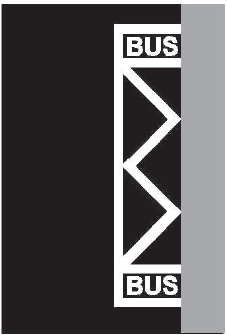 V 11a Bus or trolleybus stop The marking indicates the stopping area of the public transport vehicles shown.
Where the word BUS is replaced by the word TAXI, it is a taxi rank intended for taxis marked with a roof sign reading TAXI.
-
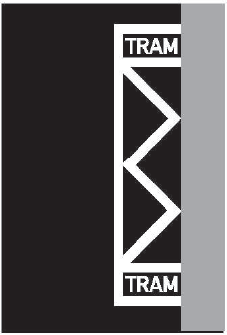 V 11b Tram stop The marking indicates the tram stopping area.
-
 V 12a Yellow zigzag line The marking indicates an area where parking is prohibited. Where the area is marked out for deliveries, it may be supplemented by the abbreviation "ZAS".
-
 V 12b Yellow box junction The marking indicates an area which the driver must not enter if the traffic situation beyond it is such that they would be forced to stop the vehicle within the marked area.
-
 V 12c No stopping The marking is laid out as a solid yellow line at the edge of the carriageway and indicates a section where stopping and parking are prohibited. It may also be marked on the kerb beside the carriageway.
-
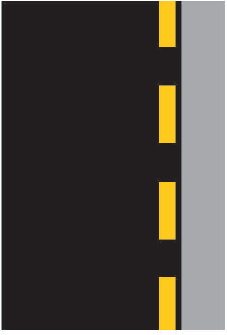 V 12d No parking The marking is laid out as a broken yellow line at the edge of the carriageway and indicates a section where parking is prohibited. It may also be marked on the kerb beside the carriageway.
-
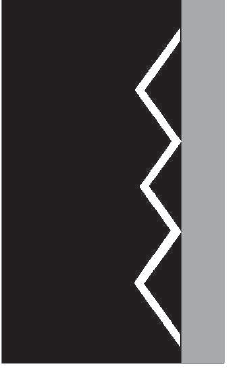 V 12e White zigzag line The marking gives advance warning of a place calling for increased caution.
-
 V 13 Chevron hatching The marking indicates an area which must not be entered or overhung with a load, unless it is necessary in order to pass an obstruction, to turn into a place lying off the road, or to enter the road from a place lying off it.
-
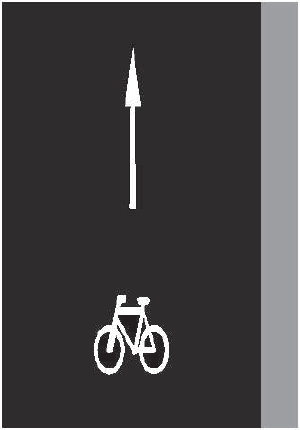 V 14 Cycle lane The marking indicates a lane or track for cyclists. In justified cases the bicycle symbol may be supplemented by a small directional arrow or arrows.
-
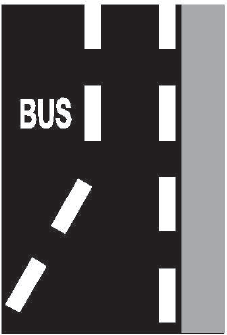 V 15 Lettering on the carriageway The marking conveys various supplementary information. Suitable symbols may also be used.
-
 V 16 Safe following distance Two chevrons between two vehicles travelling one behind the other indicate the minimum safe distance between vehicles on that road at the maximum permitted speed under normal conditions.
-
 V 17 Triangles The marking indicates the ramp onto an artificial unevenness in the carriageway, for example a road hump built into the surface.
-
 V 18 Rumble strips The marking leads the driver to reduce speed by visual and, where relevant, audible means.
The marking may also be laid out as a transverse line broken in the middle, with the gap between its two parts becoming progressively shorter in the direction of travel.
-
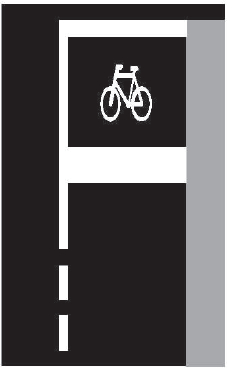 V 19 Advanced stop area for cyclists The marking indicates the area designated for cyclists waiting for the green signal.
-
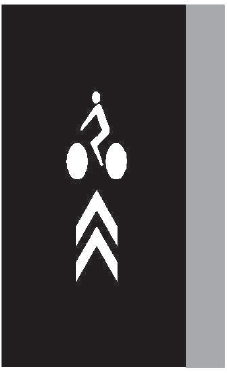 V 20 Cycle pictogram corridor The marking indicates the space and direction of travel for cyclists. It alerts drivers of motor vehicles that the road carries increased cycle traffic.