Warning signs
They warn of a hazard the driver cannot see yet. Outside built-up areas they normally stand 100 to 250 m ahead of it.
44 signs
-
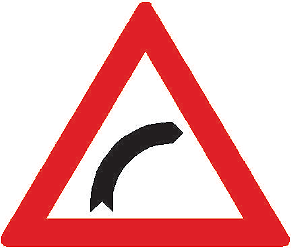 A 1a Bend to the right The sign warns of a bend (horizontal curve) to the right which cannot be taken safely without a considerable reduction in speed.
-
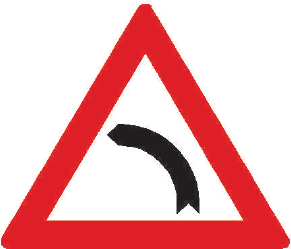 A 1b Bend to the left The sign warns of a bend (horizontal curve) to the left which cannot be taken safely without a considerable reduction in speed.
-
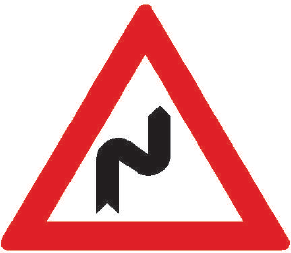 A 2a Double bend, first to the right The sign warns of two or more successive bends (horizontal curves), the first of which is to the right, which cannot be taken safely without a considerable reduction in speed.
-
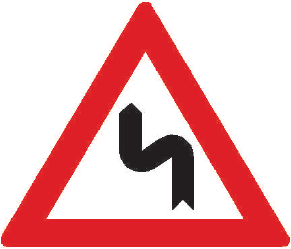 A 2b Double bend, first to the left The sign warns of two or more successive bends (horizontal curves), the first of which is to the left, which cannot be taken safely without a considerable reduction in speed.
-
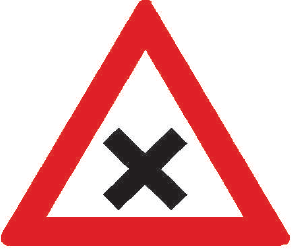 A 3 Junction The sign warns of a junction where priority is not governed by upright traffic signs. Inside a built-up area it is used only exceptionally, for example to warn of a junction at which the road is no longer the major road it was up to that point and where the rule on priority for vehicles coming from the right applies.
-
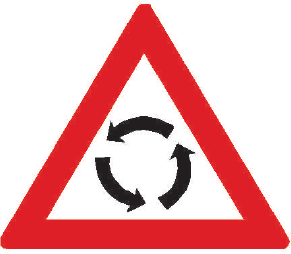 A 4 Roundabout ahead In justified cases the sign warns of a junction with a roundabout.
-
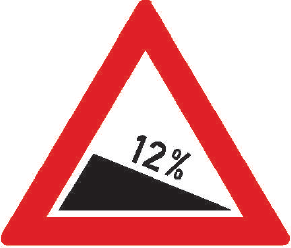 A 5a Steep descent The sign warns of a section of road where local conditions make the descent dangerous. The sign states the actual maximum longitudinal gradient of the carriageway.
-
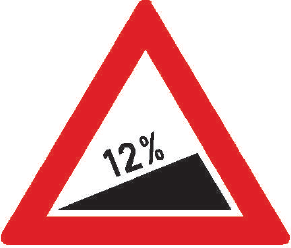 A 5b Steep ascent The sign warns of a section of road with a steep ascent. The sign states the actual maximum longitudinal gradient of the carriageway.
-
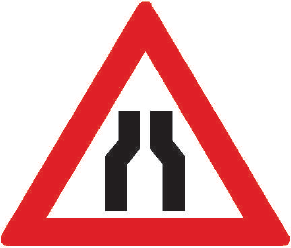 A 6a Road narrows on both sides The sign warns of a place where the carriageway narrows considerably compared with the preceding section, on both sides.
-
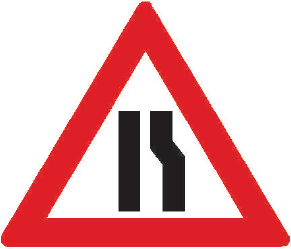 A 6b Road narrows on one side The sign warns of a place where the carriageway narrows considerably compared with the preceding section, on one side. The symbol is drawn to match the actual narrowing, either from the left or from the right.
-
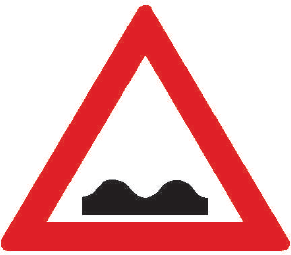 A 7a Uneven road The sign warns of bumps, potholes, holes and other unevenness in the carriageway, or of a section with an uneven surface, calling for increased caution or a considerable reduction in speed.
Where the carriageway has worn ruts, the sign is supplemented by a plate with the appropriate symbol or wording.
-
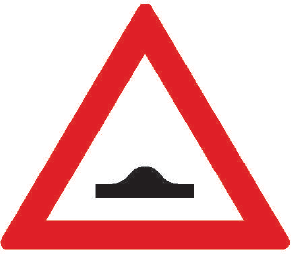 A 7b Road hump The sign warns of an artificial unevenness in the carriageway whose purpose is chiefly to reduce the speed of passing vehicles.
-
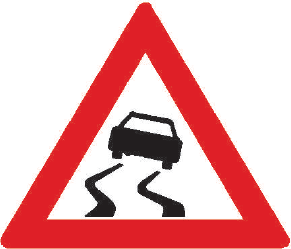 A 8 Slippery road The sign warns of a place or section of road where a vehicle may skid even in favourable weather. Where the danger arises only under certain conditions, the sign's validity is limited by a plate with the appropriate symbol.
-
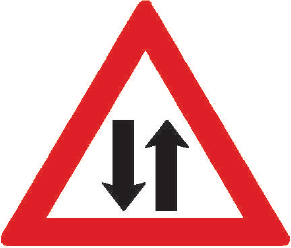 A 9 Two-way traffic The sign warns of a section of road where, unlike the preceding section, traffic runs temporarily or permanently in both directions. It also marks the end of a dual carriageway.
-
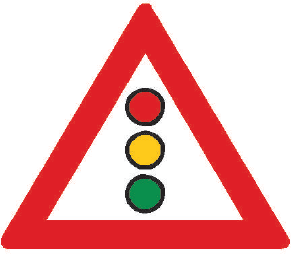 A 10 Traffic signals ahead The sign warns the driver of a place where traffic is controlled by light signals that the driver would not otherwise expect, or which, given local conditions, are not visible from a sufficient distance.
-
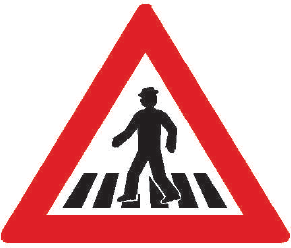 A 11 Pedestrian crossing ahead The sign warns of a pedestrian crossing that the driver would not otherwise expect and which is not visible from a sufficient distance.
-
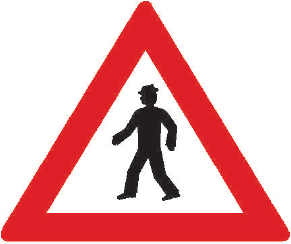 A 12a Pedestrians The sign warns of a place or section of road where pedestrians may be present in greater numbers or frequently cross the road at a point where there is no pedestrian crossing, for example at a crossing place.
-
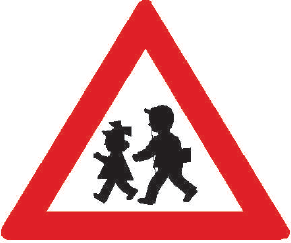 A 12b Children The sign warns of a place or section of road near which children often move about or gather, cross the carriageway, or where there is an increased risk of them running into the carriageway unexpectedly.
-
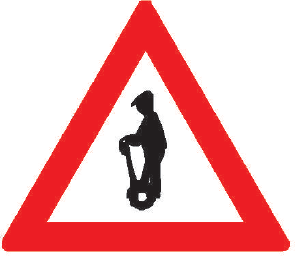 A 12c Users of personal transporters The sign warns of a place or section of road near which users of personal transporters often move about or gather, cross the carriageway, or where there is an increased risk of them riding into the carriageway unexpectedly.
-
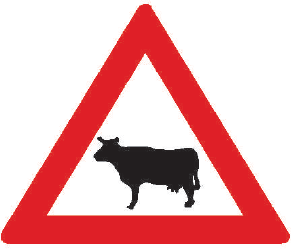 A 13 Domestic animals The sign warns of a place or section of road where domestic animals may frequently be found on the road.
Another prescribed animal symbol may be used on the sign.
-
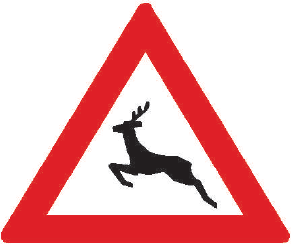 A 14 Wild animals The sign warns of a place or section of road where wild animals may frequently be found on the road.
Another prescribed symbol of a wild animal may be used on the sign.
-
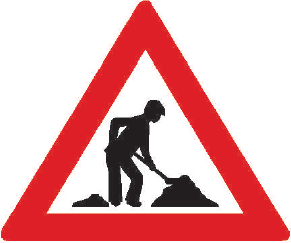 A 15 Road works The sign warns of work on the road or in its immediate vicinity which could endanger road safety, or during which the workers carrying it out could be endangered by traffic.
-
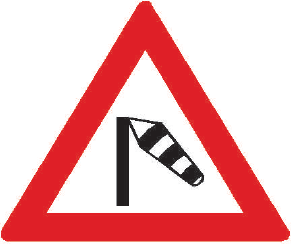 A 16 Side wind The sign warns of a place where a sudden gust of side wind may endanger road safety. Where the sign is permanent, it is normally supplemented by a wind sock showing the direction and strength of the wind.
-
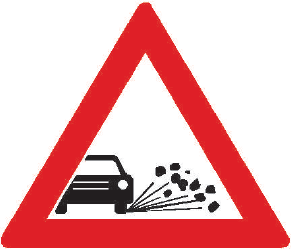 A 17 Loose chippings The sign warns of a place or section of road where loose chippings on the carriageway could endanger road users.
-
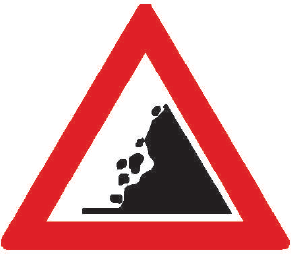 A 18 Falling rocks The sign warns of a place or section of road where rocks or earth may be present on the road as a result of landslides or falling stones.
-
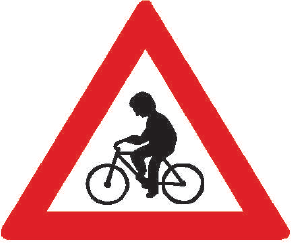 A 19 Cyclists The sign warns of a place where cyclists enter or cross the carriageway, or of a section where cyclists are frequently present.
-
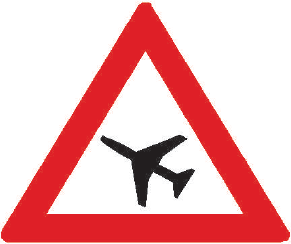 A 20 Low-flying aircraft The sign warns of a place where aircraft fly low over the road.
-
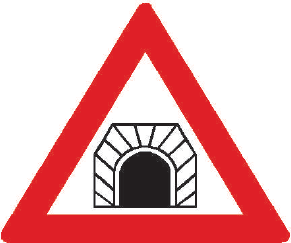 A 21 Tunnel The sign warns of a tunnel where, in addition to the general rules of the road, special rules for traffic in tunnels apply.
-
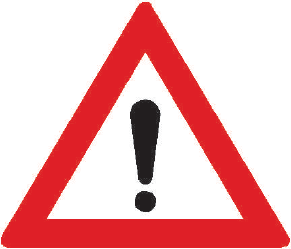 A 22 Other danger The sign warns of a danger other than one that can be indicated by a specific warning sign. A description or symbol of the other danger is normally given on a suitable supplementary plate.
-
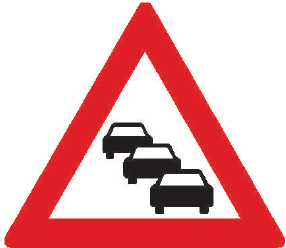 A 23 Queues likely The sign warns of the risk of a queue of stationary or slow-moving vehicles.
-
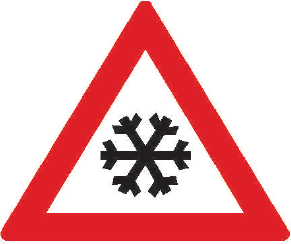 A 24 Risk of ice The sign warns of a section with an increased risk of ice on the carriageway.
-
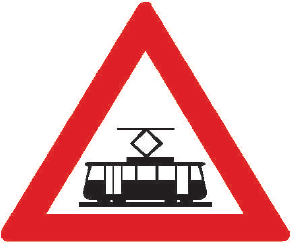 A 25 Tram crossing The sign warns of a place where a tram crosses the path of other vehicles.
-
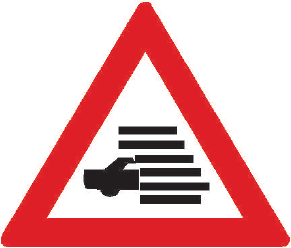 A 26 Fog The sign warns of the risk of fog or smoke.
-
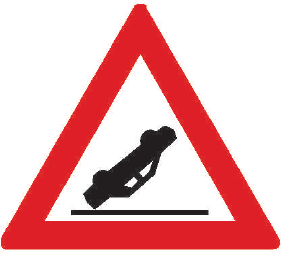 A 27 Accident The sign warns of the site of a traffic accident.
-
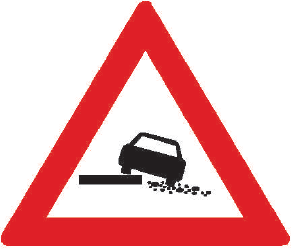 A 28 Dangerous verge The sign warns of a section of road where driving onto the verge is dangerous.
-
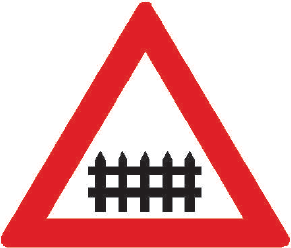 A 29 Level crossing with barriers The sign warns of a level crossing fitted with barriers.
-
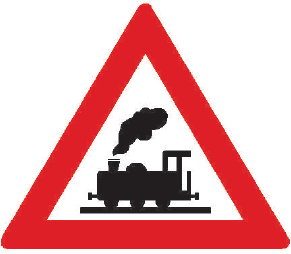 A 30 Level crossing without barriers The sign warns of a level crossing not fitted with barriers.
-
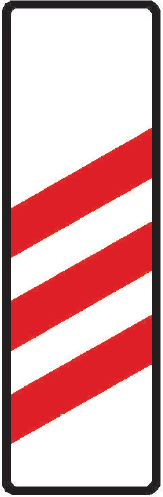 A 31a Countdown marker (240 m) The sign is placed 240 m before the level crossing it warns of. The oblique stripes point towards the centre of the carriageway. Above it stands the sign "Level crossing with barriers" or "Level crossing without barriers"; where these are used to mark a crossing on a turning road, the plate "Directional arrow" is inserted between them.
-
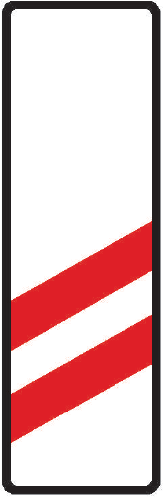 A 31b Countdown marker (160 m) The sign is placed 160 m before the level crossing it warns of. The oblique stripes point towards the centre of the carriageway. Where it is used to mark a crossing on a turning road, the plate "Directional arrow" is placed above it.
-
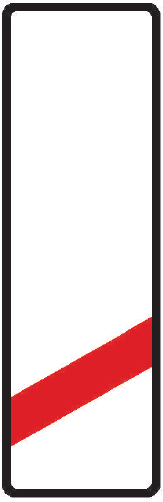 A 31c Countdown marker (80 m) The sign is placed 80 m before the level crossing it warns of. The oblique stripe points towards the centre of the carriageway. Where it is used to mark a crossing on a turning road, the plate "Directional arrow" is placed above it.
-
 A 32a St Andrew's cross, single-track level crossing The sign warns of a single-track level crossing.
Where the driver is required to stop before the level crossing, they stop before this sign.
-
 A 32b St Andrew's cross, multiple-track level crossing The sign warns of a multiple-track level crossing, where extra caution is needed in case trains pass from both directions at once.
Where the driver is required to stop before the level crossing, they stop before this sign.
-
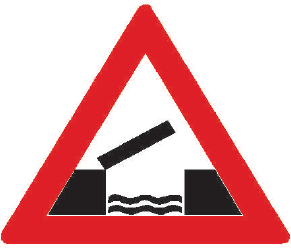 A 33 Opening bridge The sign warns of a lifting or other movable bridge.
-
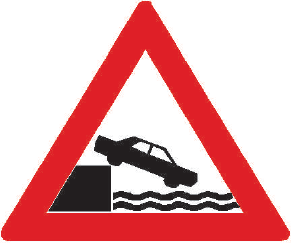 A 34 Quayside or riverbank The sign warns of a section of road leading to an unprotected quayside or the bank of a body of water.