Operational information signs
They deal with traffic on the spot: one-way streets, car parks, crossings, stops.
47 signs
-
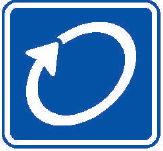 IP 1 Ring road The sign marks a ring route set up to bypass a municipality or part of it.
The name of the ring or its number, counted outwards from the centre of the municipality, may be shown on the sign or its supplementary plate. The colours may differ from the illustration.
On a motorway or road for motor vehicles, the ring may be indicated by the symbol and the name or number of the ring on an extension above the relevant part of a large direction sign.
A change of direction of the ring is shown by combining this sign with the corresponding supplementary plate in the form of a directional arrow.
-
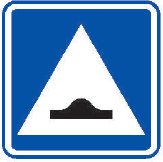 IP 2 Road hump The sign marks, at the spot itself, an artificial unevenness in the carriageway whose purpose is to reduce the speed of passing vehicles.
-
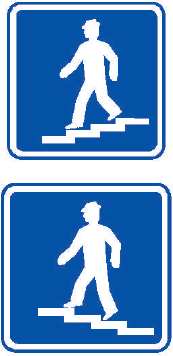 IP 3 Underpass or footbridge The sign gives notice of a nearby underpass or footbridge.
-
 IP 4a One-way traffic The sign indicates the direction of travel on a one-way road.
-
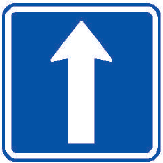 IP 4b One-way traffic The sign indicates the direction of travel on a one-way road.
-
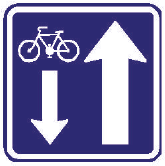 IP 4c One-way traffic with contraflow cycling The sign indicates the direction of travel on a one-way road and indicates that cyclists are permitted to ride in the opposite direction.
-
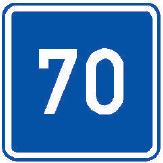 IP 5 Recommended speed The sign recommends to the driver, where other traffic conditions allow, the speed shown on it as a figure in kilometres per hour, which may be regarded as safe.
Circumstances that must be taken into account include heavy traffic, poor condition of the road, fog, ice and the like.
-
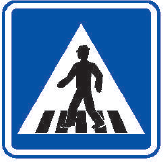 IP 6 Pedestrian crossing The sign marks a pedestrian crossing indicated by the road marking "Pedestrian crossing", chiefly away from a junction.
-
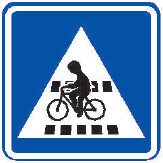 IP 7 Cycle crossing The sign marks a cycle crossing indicated by the road marking "Cycle crossing", chiefly where the driver would not otherwise expect it.
-
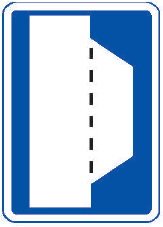 IP 9 Emergency lay-by The sign marks a place (area) reserved for emergency stopping.
Where the place is equipped with an emergency telephone, the sign is supplemented by the word "SOS" placed within the depiction of the lay-by.
-
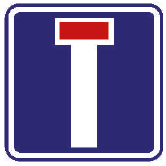 IP 10a No through road The sign marks a road which ends ahead or along which it is not possible to continue.
The sign may also be used to mark a road along which it is not possible to continue except by bicycle.
-
 IP 10b Advance sign for a no through road The sign gives advance notice of a road which ends ahead or along which it is not possible to continue.
It may also be used as an advance sign for a road along which it is not possible to continue except by bicycle.
-
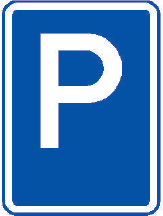 IP 11a Parking The sign marks a place where stopping and parking are permitted.
The manner of parking, or the type of vehicle for which the car park is intended, may be shown on the sign or on a supplementary plate.
-
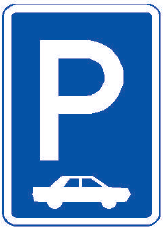 IP 11b Parking, perpendicular or angled The sign marks a place where stopping and parking are permitted.
The symbol in the lower part of the sign indicates the prescribed manner of parking. When parking perpendicularly or at an angle, the position of the vehicle must match the position shown by the symbol on the sign or supplementary plate.
-
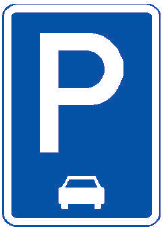 IP 11c Parking, parallel The sign marks a place where stopping and parking are permitted.
The symbol in the lower part of the sign indicates the prescribed manner of parking.
-
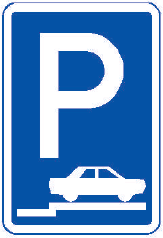 IP 11d Parking on the pavement, perpendicular or angled The sign marks a place where stopping and parking are permitted.
The symbol in the lower part of the sign indicates the prescribed manner of parking. When parking perpendicularly or at an angle, the position of the vehicle must match the position shown by the symbol on the sign or supplementary plate.
A vehicle with a maximum permissible weight exceeding 3,500 kg, a single-axle tractor, a powered hand truck or a self-propelled working machine must not stop or park on the pavement.
-
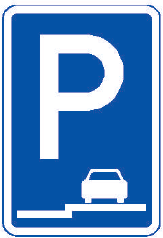 IP 11e Parking on the pavement, parallel The sign marks a place where stopping and parking are permitted.
The symbol in the lower part of the sign indicates the prescribed manner of parking.
A vehicle with a maximum permissible weight exceeding 3,500 kg, a single-axle tractor, a powered hand truck or a self-propelled working machine must not stop or park on the pavement.
-
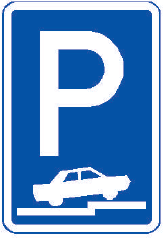 IP 11f Partial parking on the pavement, perpendicular or angled The sign marks a place where stopping and parking are permitted.
The symbol in the lower part of the sign indicates the prescribed manner of parking. When parking perpendicularly or at an angle, the position of the vehicle must match the position shown by the symbol on the sign or supplementary plate.
A vehicle with a maximum permissible weight exceeding 3,500 kg, a single-axle tractor, a powered hand truck or a self-propelled working machine must not stop or park on the pavement.
-
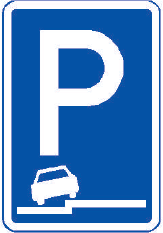 IP 11g Partial parking on the pavement, parallel The sign marks a place where stopping and parking are permitted.
The symbol in the lower part of the sign indicates the prescribed manner of parking. The symbol may be reversed.
A vehicle with a maximum permissible weight exceeding 3,500 kg, a single-axle tractor, a powered hand truck or a self-propelled working machine must not stop or park on the pavement.
-
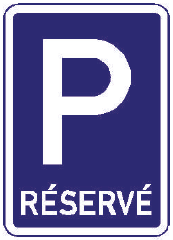 IP 12 Reserved parking The sign marks a place where only the vehicles for which the parking is reserved may stop and park.
Details of who the parking is reserved for and, where relevant, at what times are given on a supplementary plate, or may be shown on the sign in place of the wording. Outside the times for which the parking is reserved, drivers of other vehicles may also stop and park there, unless general or local traffic regulation provides otherwise.
Any prescribed manner of parking is indicated in the same way as on the "Parking" signs showing the manner of parking. A sign bearing the symbol of a facility or space for wheelchair users is always accompanied by the road marking "Parking reserved for a vehicle carrying a person with a severe disability or a severe mobility impairment".
A sign with the symbol of an electric vehicle supplemented by a plate reading "CHARGING ONLY" marks a place reserved for parking only while charging. This sign is always accompanied by the road marking "Lettering on the carriageway" with the symbol of a charging station.
-
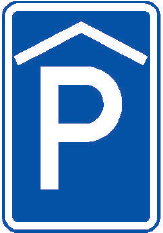 IP 13a Covered car park The sign gives notice of a covered car park or parking garage.
Any prescribed manner of parking is indicated in the same way as on the "Parking" signs showing the manner of parking.
-
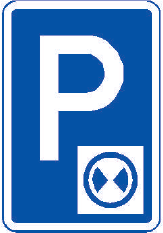 IP 13b Parking with a parking disc The sign marks a car park where, on beginning to park, the driver must display a disc visibly in the vehicle and set on it the time at which parking began, which must not be changed until departure.
Any prescribed manner of parking is indicated in the same way as on the "Parking" signs showing the manner of parking.
-
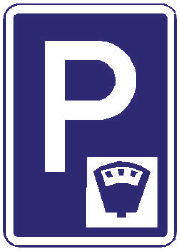 IP 13c Parking with a ticket machine The sign marks a paid car park. The driver must follow the details on the sign, the supplementary plate or the ticket machine.
Any prescribed manner of parking is indicated in the same way as on the "Parking" signs showing the manner of parking.
-
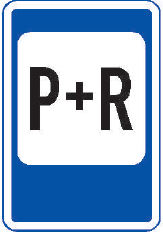 IP 13d Park and ride The sign marks a car park from which the journey can be continued by public transport.
-
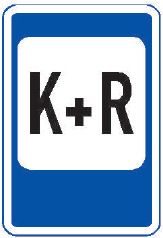 IP 13e Kiss and ride The sign marks a parking area where a vehicle may stop to set down and pick up passengers.
-
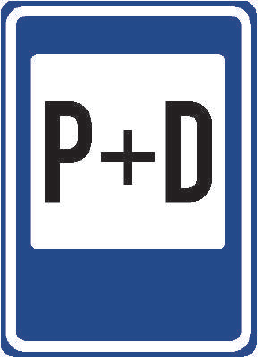 IP13f Park and share The sign marks a car park intended for vehicles whose driver continues the journey directly from there as a passenger in another vehicle.
-
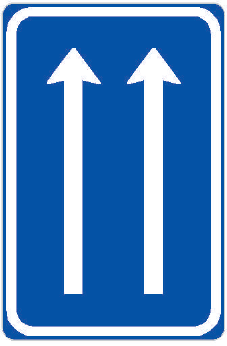 IP 16 Lane layout The sign shows the number and layout of lanes. Lanes in the opposite direction may also be shown on the sign.
-
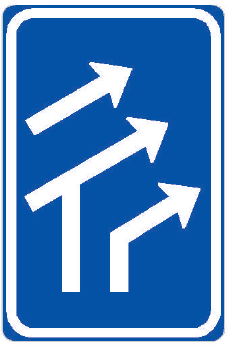 IP 17 Lane layout The sign shows the number and layout of lanes. It also shows which lane runs through.
-
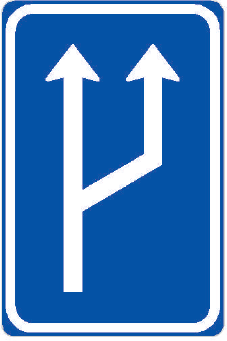 IP 18a Increase in the number of lanes The sign shows the number and layout of lanes.
-
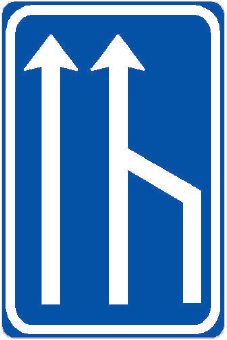 IP 18b Reduction in the number of lanes The sign shows the number and layout of lanes. It also shows which lane runs through.
-
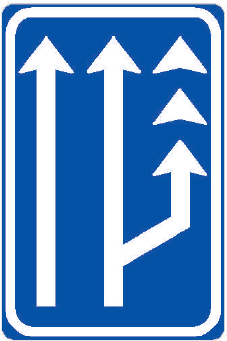 IP 18c Crawler lane The sign shows the number and layout of lanes. It also marks an additional lane on a motorway or road for motor vehicles intended for motor vehicles which, in the marked section, cannot reach a speed of at least 80 km/h. Other motor vehicles use the crawler lane where their speed in that section is markedly lower than that of other vehicles travelling in the same direction.
-
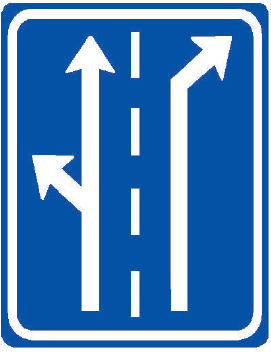 IP 19 Lane arrangement before a junction The sign shows how to get into lane before a junction or a turning-off point, and the prescribed direction of travel. In justified cases the symbol of the relevant information sign may also be used, provided that the lane in question leads only to that destination.
By using the symbol of the supplementary plate "Permitted direction for cyclists", a different lane arrangement may be laid down for cyclists.
-
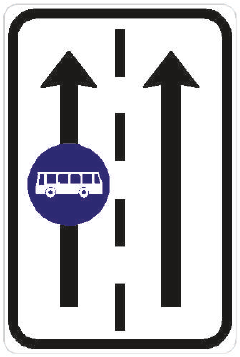 IP 20a Reserved lane The sign marks a lane reserved for public passenger transport vehicles and its position relative to the other lanes. The reserved lane is at the same time marked on the road by road markings, chiefly "Solid longitudinal line" or "Broken longitudinal line", and by the word "BUS". The times during which the lane is reserved may be shown in the lower part of the sign or on a supplementary plate.
Lanes in the opposite direction may also be shown on the sign.
Where the lane is reserved for another type of vehicle or for a particular purpose, the relevant symbol or suitable wording is shown in the blue field. Where the blue field reads TAXI, the reserved lane is intended for taxis marked with a roof sign reading TAXI.
The position of a lane reserved for a particular type of vehicle relative to the other lanes may be shown by inserting the symbol of this sign into another sign showing the number and layout of lanes or the lane arrangement.
-
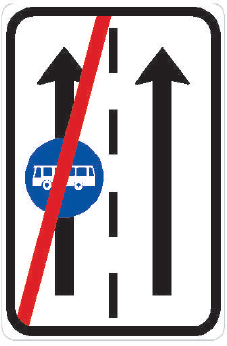 IP 20b End of reserved lane The sign ends the reserved lane.
-
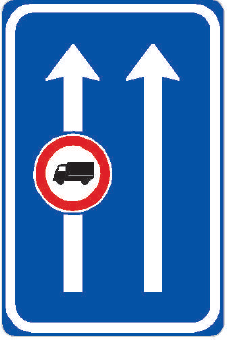 IP 21 Restriction in a lane The sign shows the number and layout of lanes and expresses, for a particular lane, the restriction or hazard arising from the symbol of the relevant upright traffic sign used.
-
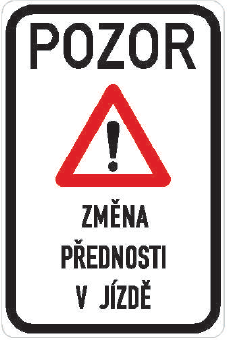 IP 22 Change in traffic arrangements By suitable wording and a symbol, the sign warns of a change in local traffic regulation, a change in traffic arrangements, an unusual road layout, a place with frequent accidents and the like.
-
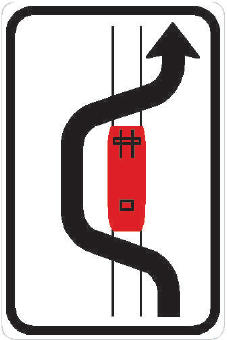 IP 23a Passing a tram on the left The sign marks a place where a tram standing at a stop may be passed on the left.
-
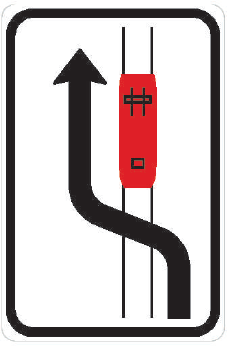 IP 23b Passing a tram on the left (travelling alongside) The sign marks a section of road where travelling alongside a tram on its left is permitted.
-
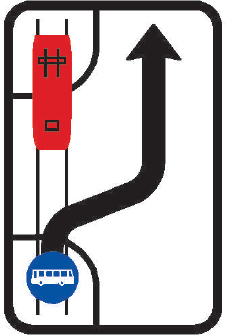 IP 23c Public transport vehicles leaving the tram lane The sign marks the place where public transport vehicles, chiefly buses, leave the tram lane.
Where the driver of a vehicle for which a lane is reserved moves from the reserved lane into the adjacent lane, the driver travelling in that lane must allow them to do so by reducing speed or, if necessary, by stopping.
-
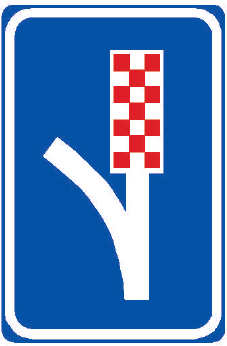 IP 24 Escape lane The sign gives notice of an escape lane where, in an emergency such as reduced braking performance, a vehicle can be stopped by auxiliary means such as an upward slope, a coarse gravel surface and the like.
-
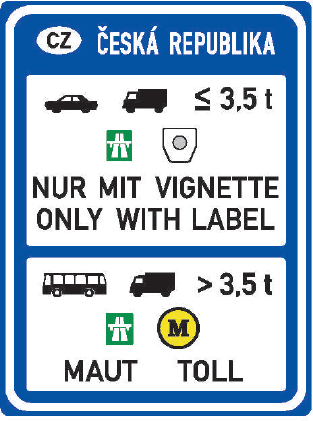 IP 28a Road charging The sign informs drivers entering the Czech Republic of the duty to pay a time-based charge or a toll. The text on the sign is normally given in the language of the neighbouring state and in English.
-
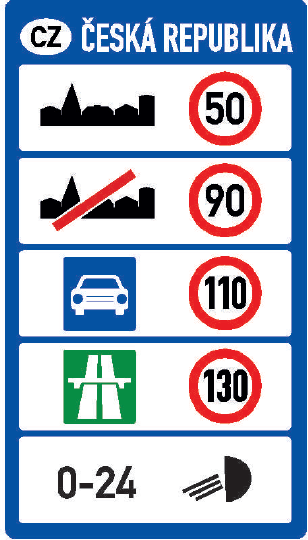 IP 28b Maximum speed limits The sign informs drivers entering the Czech Republic of the generally applicable maximum speeds in built-up areas, outside built-up areas, on motorways and on roads for motor vehicles, and of the duty to drive with lights on during the day.
-
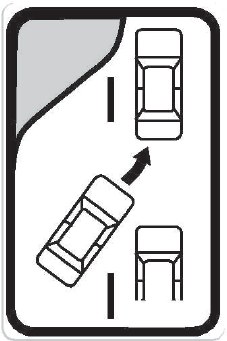 IP 29 Zip merge The sign marks or emphasises a place where, during side-by-side driving, vehicles must merge alternately into the through lane. The symbol on the sign may be reversed.
-
 IP 30 State border The sign marks the proximity of the state border when entering the Czech Republic. When leaving the Czech Republic, the sign gives the name of the neighbouring state.
-
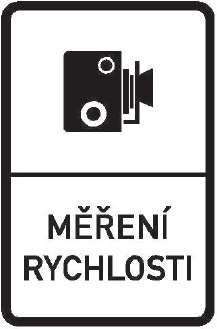 IP 31a Speed enforcement The sign marks the start of a section where speed is measured by the municipal police.
-
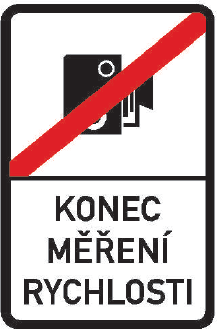 IP 31b End of speed enforcement The sign marks the end of the section where speed is measured by the municipal police.
-
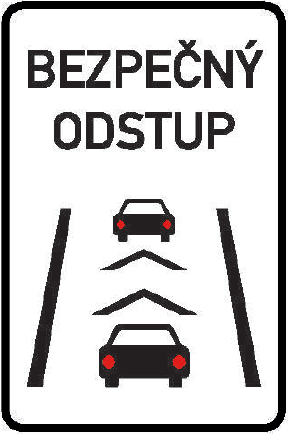 IP 32 Safe following distance In conjunction with the corresponding road marking "Safe following distance", the sign gives information about the safe distance between moving vehicles.
Two chevrons between two vehicles travelling one behind the other indicate the minimum safe distance between vehicles on that road at the maximum permitted speed under normal conditions.